
Money Laundering = Fraud ... is it?
In the banking / FI world, Fraud and Money Laundering as risks are used interchangeably. We need to be a a lot more careful though!
Abhishek Dwivedi
6/30/20213 min read
Let's get the obvious point out of our way by saying all kinds of Financial Crimes, irrespective of type, are inter-related one way or another and need measures to either stop them or control them.
Coming from the AML/CFT transaction monitoring domain, I have been confronted by this interchanging terminology a lot of times. Whenever I would introduce myself to business users (Relationship managers and the likes), a quick intelligent reply would come back "ah so you help stopping fraud, great!" OR "you must be too busy nowadays as cyber fraud is at peak" and so on... As COVID restrictions have started to relax in Netherlands, I met someone new in our neighbourhood. After casual chat we started discussing work side of things and again a smart answer defining my AML experience to solve "fraud" came up! This just demonstrates that the confusion goes far and wide ;-)
Back to the original question. If you are in the banking profession, you may have used fraud/money laundering term interchangeably. For an outsider (someone who is not a Fraud and/or an AML expert), more often than not, these are one and the same thing. It's mostly because both deal with Financial Economic Crime. In this article I would like to dig a bit deeper and bring out the differences for this target group as understanding the difference is as important as "knowing" the similarity.
The basics first
Let's start with fraud. It's an act performed by an external person (in most cases), compromising the security infra of a bank and stealing money from the bank (and in most cases bank's customers). On the other hand, as a bank, your own customer may be bringing dirty money to clean it up and channel it via your products/services. I have tried to summarise the comparison below:


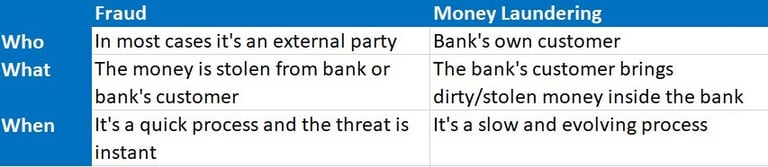

As you will notice there is a clear distinction between the two. A threat coming from fraud has to be tackled instantly whereas identifying money laundering is a slow and lengthy process.
Why distinction is necessary?
I will immediately take you to the detection side of things as it will help in proving why we need to understand these two in isolation.
A bank has to detect and prevent a fraud attempt almost instantly. As customer's hard earned savings are at stake, no one wants an outsider gaining illegal access. Since in this day and age of everything being digital, vulnerabilities are exploited by fraudsters almost every minute. This is the primary reason fraud detection/prevention has to rapidly adapt with changing threats. More often than not fraudsters will not use the same technique all over again because in all likelihood banks may have closed the loophole already (also communicated with other banks to do the same).
Now let's consider the money laundering side of things. There is no external party here. As a bank, you have done good due diligence on your customer , apparently you "Know Your Customer" very well and now it's time to question their ongoing financial activity! You cannot do so in an instant and it will be a bit novice to do so either. This is the reason banks have to take their own time in understanding the activity of their customer, distinguish between a good vs. bad behaviour and finally escalate a select few behaviours which potentially look like a "suspicious behaviour". There are so many ifs and buts and it has a reason. First of all you are questioning your own customer and secondly you can only raise suspicion (which is not saying this indeed was a money laundering activity). Unless convicted in the court of law you cannot point fingers at this customer. With so many uncertainties around, the launderers keep on repeating their schemes (to stay under the radar) in the same bank as well as different banks. They know very well how everyone works in their own silos. In summary any monitoring or investigation activity around money laundering is a slow and lengthy process because unless you are sure, you cannot act.
Conclusion
I was reading a few posts on LinkedIn and followed some of the comments on these posts. The summary as I could gather was - fraud investigators are on top of their game as their quick actions help in stopping quantifiable fraudulent attempts. On the contrary AML investigations are relatively boring because you never know whether the person you have reported is indeed a criminal or not. I definitely do not want to pitch one against another but simply want to demonstrate these are two different worlds and we need to deal with them differently and appreciate the difference. As long as this difference is clear we can handle them well too.